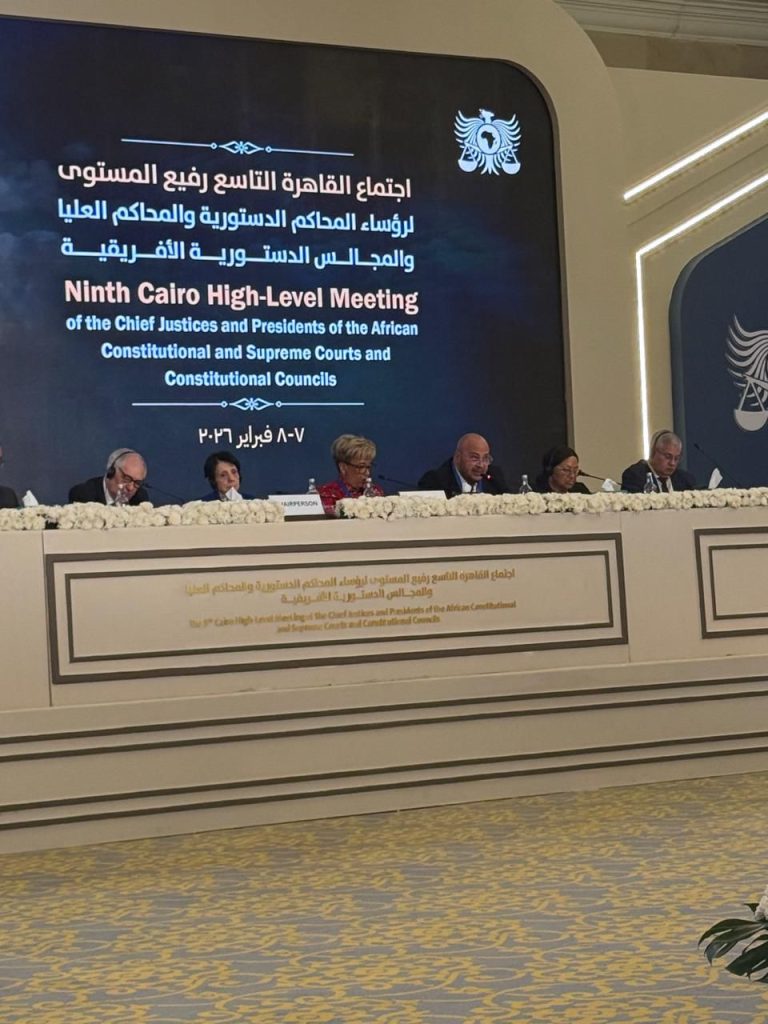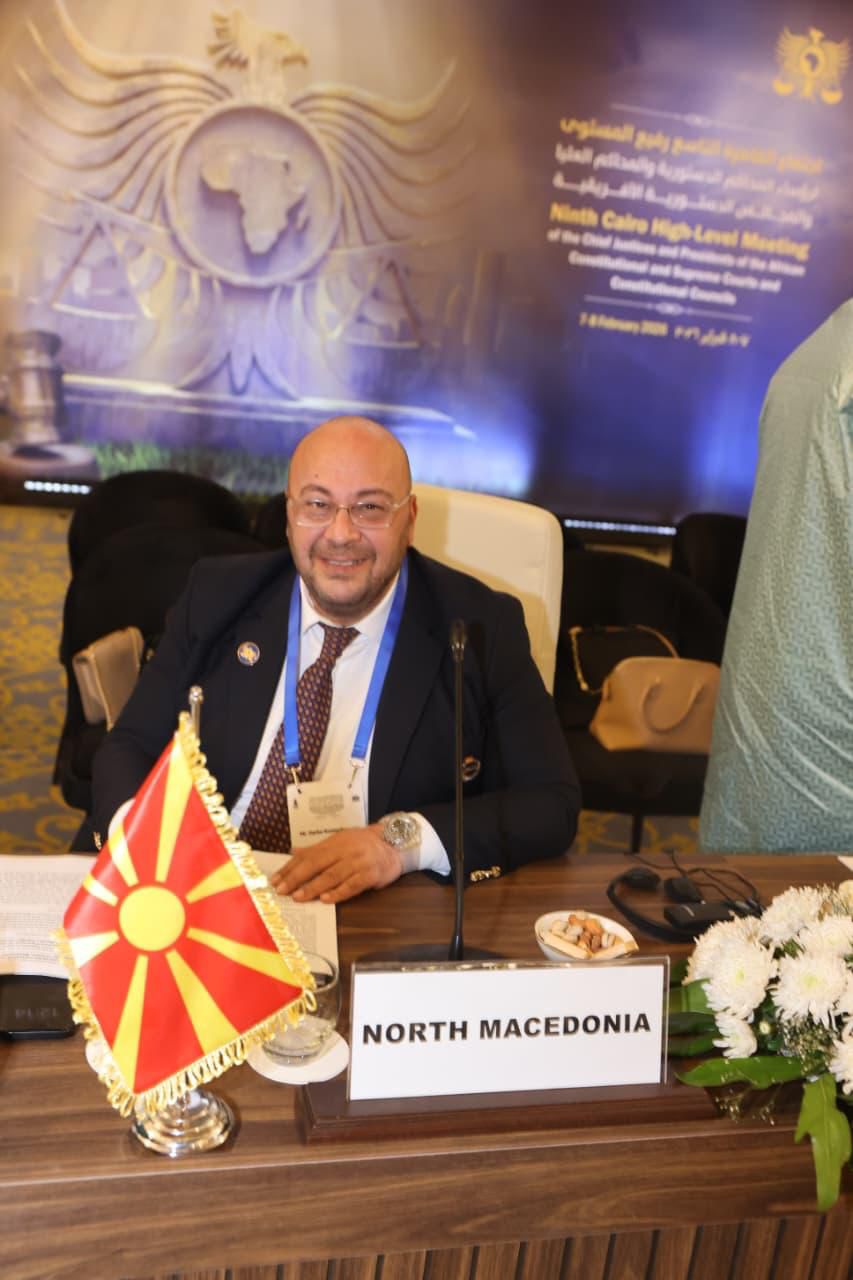
The President of the Constitutional Court, Darko Kostadinovski LLD, addressed the 9th High-Level Meeting of Presidents of Constitutional Courts, Supreme Courts and Constitutional Councils of Africa, held on 7 and 8 February in the Arab Republic of Egypt. The event focused on contemporary challenges in constitutional justice.
Kostadinovski LLD delivered remarks during the session dedicated to the independence of constitutional justice, where he also participated in his capacity as representative and Chair of the Balkan Constitutional Courts Forum (BCCF). In his address, Kostadinovski LLD spoke on the topic “Constitutional Judiciary in the Republic of North Macedonia: The Path from Rigid Formalism to Living Constitutionalism”.
Below is the full address of President Darko Kostadinovski:
Constitutional judiciary in the Republic of North Macedonia: the Path from Rigid Formalism to Living Constitutionalism
Esteemed President of the Supreme Constitutional Court of Egypt, Mr Boulos FAHMY Iskandar,
Esteemed colleagues,
It is an honour to address this exceptionally important meeting, at which views and experiences will be exchanged on the present and the future of constitutional justice in Africa. Today, I am with you both as the President of a constitutional court from another continent and as the Chair of the Balkans Constitutional Courts Forum, with the aim of sharing with you my perspectives on the significant developments in constitutional judiciary in Macedonia, in the Balkans, and in Europe.
Dear guests,
The roots of constitutional justice in our region run very deep. Three years ago, we in Macedonia marked a major jubilee, sixty years of constitutional judiciary. As part of the federal state of Yugoslavia, the Constitutional Court in Macedonia was established as early as 1963. Within the then Yugoslav constitutional order, the Constitutional Court formed part of the so-called unity of power, with competences that were significantly more limited than those of the constitutional court in independent Macedonia, which commenced in 1991. With the Constitution of 1991, the Constitutional Court was established as a body entrusted with safeguarding the Constitution, maintaining constitutionality and legality, and protecting the freedoms and rights of the individual and the citizen, and as a sui generis body, the Court was excluded from the separation of powers, i.e., it was positioned above the three branches of power, the legislative, the executive and the judiciary, as their controller. Just as the differences in competences were substantial, so too were the challenges facing the Court in a democratic system. One thing was clear, that the expectations of the citizens were equally great. In my own society, I am known for my harsh realism and a strong sense of self-criticism. If I observe and analyse the present constitutional reality in Macedonia, only one conclusion can be considered objective. From independence until two years ago, the Constitutional Court largely failed to meet the expectations of the citizens. Quite simply, it did not succeed in assuming the role assigned to it by the constitution-makers, it did not fight for its full autonomy and independence, it failed to free itself from the “grip of politics”; in certain periods it was excessively accommodating towards political power, and at times it was even perceived as a “regional unit of the Government”! The current state of the rule of law in Macedonia, and the citizens’ lack of trust in the system of government as a whole, confirm this assessment. Let me provide you with one further indicator, over the past 7 years, I have authored 57 dissenting opinions, something that does not reflect well on the Court!
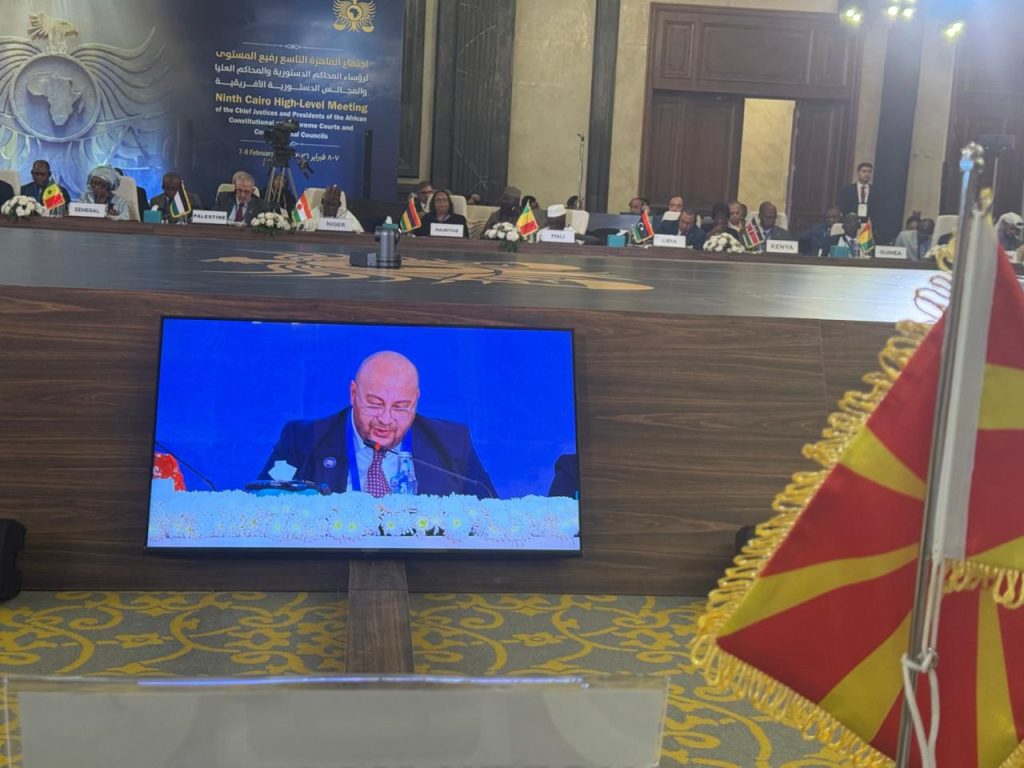
Esteemed colleagues,
This reality in Macedonia has begun to change significantly over the past two years. In May 2024, the Constitutional Court adopted a new Act of the Court. As a result of judicial activism, increased courage and determination of the judges, and by making use of the constitutional possibility for the Court to act as a self-regulating body (given that Macedonia is a unique example in Europe in that there is no law on the Constitutional Court and the Court is therefore self-regulating), the Constitutional Court itself introduced substantial innovations aimed at more efficient operation, at strengthening its status, administrative and budgetary independence, and at enhancing the protection of the Constitution. In such a manner, the Constitutional Court, in a way followed the practice of European courts and gradually moved away from rigid formalism and from the strict Kelsenian concept of the “negative legislator”, transitioning towards the concept of living constitutionalism, within which it is inevitable to cross the boundary towards a “positive legislator”! Through the Act of the Court, the scope of our competence was expanded from formal review of constitutionality to responsibility for interpreting the Constitution in a manner that responds to the needs of society and ensures effective protection of fundamental rights. Such judicial activism, the increased courage and determination of the judges, and my position as President that there can be no compromises with politics, have begun to yield tangible results. In the recent period, through the proceedings and decisions of the Constitutional Court, we have witnessed unease among politicians and unease within state authorities, the Assembly and the Government, which is, without doubt, a significant indicator that the Constitutional Court is on the right path. We believed, and continue to believe, that if the Constitutional Court stands at the apex of the pyramid of the rule of law, it must assume responsibility, and that only in this way can we fulfil the very essence of constitutionality and legality and of the rule of law, which means: that the Constitution is lex imperium; that no one possesses more authority than that conferred upon them by the Constitution and the laws; that no one is above the Constitution, and that everyone is obliged to respect the Constitution.
Dear all,
This has so far been briefly devoted to our constitutional reality. Allow me now to retain your attention on the matter connected to my previous remarks, for which I have personally advocated over the years, both as a judge and as President of the Macedonian Constitutional Court, as well as in my scientific work, by promoting the theory of so-called “moderate living constitutionalism”.
The Constitution is the backbone of a state’s legal and political system and the primary source of law. It is well known that the Constitution lays down the foundations upon which a legal system is built and operates, containing the rules of social organisation and the rules of governance, with the fundamental aim of protecting the basic freedoms and rights of the individual and the citizen. However, it is a fact that the Constitution is a living organism, intended to endure through different historical and social phases. Naturally, constitutional judiciary, too, cannot ignore changes.
“The world as we have created it is a process of our thinking. It cannot be changed without changing our thinking”, are the words of the great Einstein. If that is so, as indeed it is, then it is clear that changes in the global world, as a result of changes in modes of thinking, necessitate acceptance of and adaptation to those changes. In constitutional judiciary, this is made possible through the theory of “living or real constitutionalism”!
As I mentioned earlier, as a result of judicial activism, which lies at the very core of this concept, the Constitutional Court itself introduced two significant innovations in constitutional judiciary. The first is the introduction of what, in European constitutional jurisprudence, is referred to as an “interpretative decision”. The essence of this type of decision is that the Court has undertaken a preliminary review of constitutionality, expressed doubts and initiated proceedings, and in its resolution has set out its legal reasoning, while postponing the final decision and imposing a time limit on the authority that adopted the contested regulation to bring it into conformity, under the coercive “threat” of a repealing or annulling decision. The rationale behind this innovation is to enable the Court to preserve the integrity of the legal order while granting the authority that adopted the contested regulation a further (time-limited) opportunity to correct itself and return to the sphere of constitutionality, so as to avoid the creation of legal gaps that could have serious implications for the legal order.
The second innovation consists in the introduction of the possibility for the Court to monitor the realisation of constitutionality, legality, and the freedoms and rights of the individual and the citizen guaranteed by the Constitution, and, at its own discretion, to adopt a special report indicating the need for measures to ensure their implementation and protection, which is then submitted to the competent authority.
The benefit of this type of decision of the Constitutional Court has already been confirmed in two concrete cases, one of which has been successfully concluded, while the other is still ongoing.
The introduction of interpretative decisions and special reports on constitutionality, as a result of judicial activism and of creative, innovative and visionary interpretation of constitutional values and norms in accordance with the spirit of the time, thereby expanding the competences of the Constitutional Court, represents a form of “soft” revision of the text of the Constitution. In this manner, judicial activism and changes in judicial practice shape the real appearance of the Constitution, and of the order established by it, perhaps even more effectively than the explicit norms it contains.
In reality, both the explicit and the implicit competences of the Constitutional Court lead to a constant, greater or lesser, step beyond the role of the Constitutional Court as a negative legislator and to an “incursion” into the sphere of action of the positive legislator. Reactions to such “incursions” on the part of the positive legislator vary and depend on the particular case. The discussion on the mutual relationship between positive and negative legislators is highly interesting, but by no means simple or straightforward. Within this complex relationship, reality is grounded in the fact that the defensive role of the Constitutional Court in safeguarding the Constitution is no longer its sole role today, and in many countries with stable democracies it is no longer even its most important role. In many cases, constitutional courts have begun to determine the constitutional legitimacy of the laws they examine, and their decisions in such cases have had significant consequences. This development was the result of the fact that, in the second half of the twentieth century, constitutional courts not only defended the Constitution but also began to interpret it. The “interpretative” role of constitutional courts, as opposed to their original “defensive” function, has had a positive impact on the promotion of general standards and guidelines for the action of public authorities. In this way, by interpreting the Constitution, constitutional courts began to provide state authorities with conceptual tools and standards for action. Accordingly, constitutional courts today no longer have merely a defensive task of protecting the Constitution, but also play an important role in the creation of a comprehensive legal order.
This “new role” of the Constitutional Court represents a significant limitation on the power of the legislative body. The very existence, alongside the positive and the negative legislator, means that antagonism between the “two legislators” is almost inevitable.
However, this antagonism can nevertheless be mitigated.
Like other constitutional courts in Europe, the Macedonian Constitutional Court, operating under the conditions of contemporary or so-called “new constitutionalism”, by abandoning formalism and embracing judicial activism, has adopted and refined mechanisms such as interpretative decisions and special reports for the protection of constitutionality, with the aim of avoiding and/or alleviating antagonism between the positive and the negative legislator, these mechanisms foster constitutional culture, dialogue, cooperation and respect!
Esteemed colleagues,
I wished to share with you the concept of living constitutionalism, the significant innovations we have introduced, and the changed circumstances in constitutional judiciary in Macedonia over the past two years, as a source of inspiration for possible changes in some of your constitutional courts. After all, visionary interpretation of constitutional norms formed part of the Madrid Communiqué of the 6th Congress of the World Conference on Constitutional Justice, which many of you attended, and which states, I quote, that “constitutional courts have the task, through their decisions, to interpret the Constitution and to develop principles, thereby laying legal foundations that transcend electoral cycles and political agendas. The participants confirmed that the protection of the dignity, rights and freedoms of future generations is a constitutional imperative. Courts must ensure that today’s judicial decisions do not hinder the freedoms and well-being of future generations”. Courts must not become instruments of the will of the majority, nor isolate themselves from the societies they serve. Their legitimacy lies in their constitutional mandate, legally reasoned decision-making, procedural transparency, and the courage to decide in accordance with the constitutions, even when such decisions are politically undesirable.”
In conclusion, long ago the Greek philosopher Heraclitus observed that “the only constant in life is change”. If this is so, and indeed it is, it is only natural that the question arises of how to overcome the “fear of change”, which also represents a constant in life. The answer is not simple, but the first step would be to turn to ourselves and to change with respect – to change the political, legal, and constitutional culture. To build a society governed by the rule of law, and not by the rule of man. “Today, the highest act of patriotism is genuine commitment to the rule of law” – this is the thought with which, over the past two years, I have begun and concluded all of my public addresses!
Thank you.