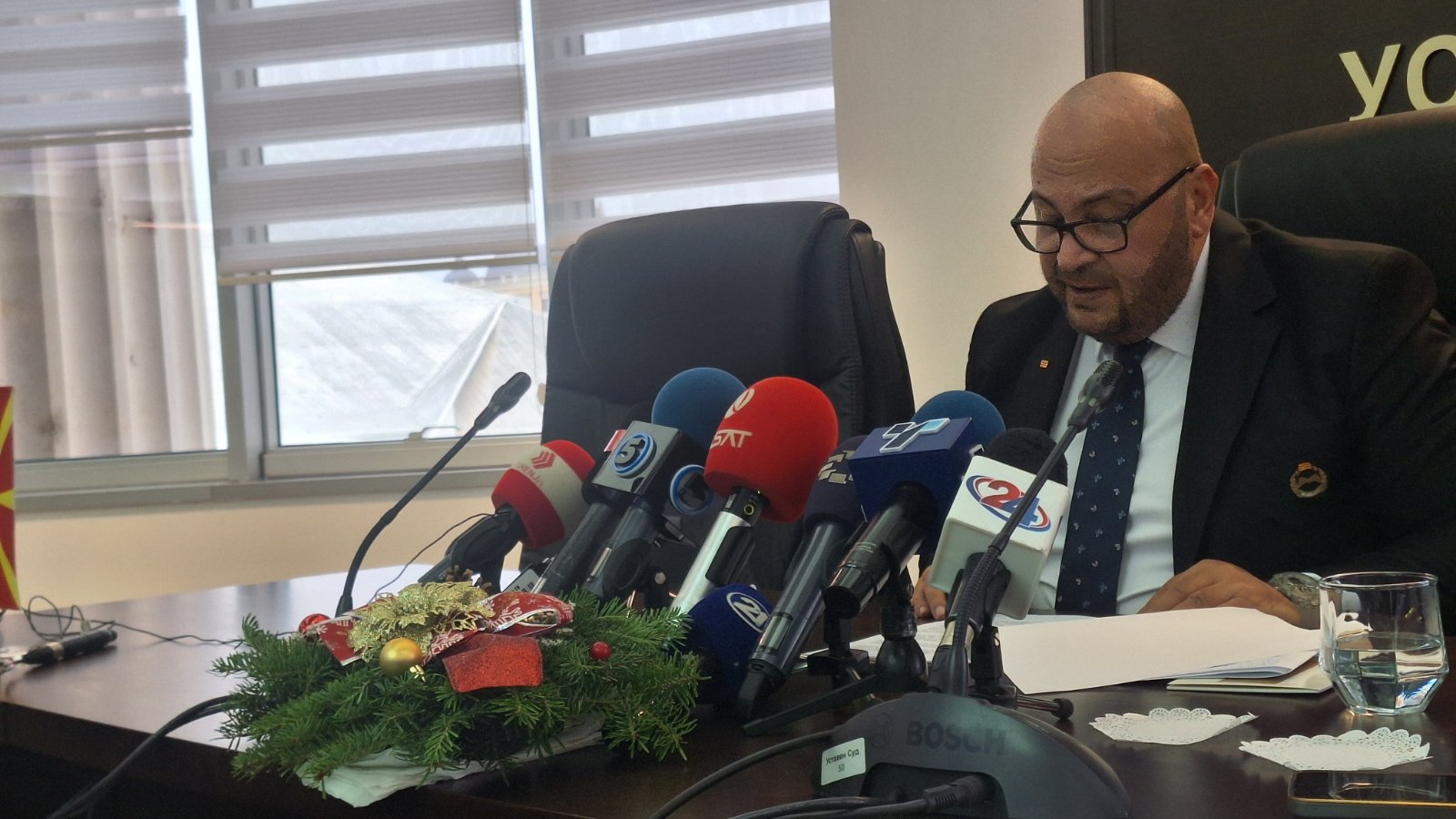
Dear representatives of the media,
At the end of 2025, it is my duty to inform the public and the citizens about the overall state of affairs and the work of the Constitutional Court over the past year.
We are concluding a year in which the Court operated efficiently and transparently, amid heightened expectations and complex challenges.
In the context of dynamic socio-political processes, the Court, despite pressures and attempted influences, remained a firm pillar of the rule of law and an inviolable guardian of the Constitution.
With a strong sense of responsibility and profound respect for the citizens, I can confirm that the Constitutional Court fulfilled the entrusted mandate professionally, independently, and impartially.
When assessed through the prism of the sensitive cases we examined and the decisions we adopted, it must be said that the process was neither easy nor straightforward, nor were our decisions always met with public approval. Nevertheless, in reaching our decisions we were guided by one single objective: loyalty to the Constitution, above all political, economic, and party-political attempts at influence.
Dear all,
Public trust in the Constitutional Court continues to grow, as evidenced by the following facts. This year, to date, we have registered 306 cases, the highest number since the establishment of the Court. Of these, 271 are initiatives and applications submitted by citizens; 7 by political parties; 8 by state organisations and public enterprises; 3 by municipalities; 2 by religious communities; 11 by state authorities; and 2 cases were initiated by own initiative by the Court.
These figures allow me to express sincere satisfaction with the trust shown, as it is increasingly clear that citizens view the Constitutional Court as a legal refuge, an institution where protection can be found.
A review of the statistical data indicates that this year we resolved 230 cases, a figure broadly comparable to last year and above the average for the past five years. The majority of resolved cases were initiated in the previous year. The oldest case resolved by the Court dated back to 2017 and concerned the Law on Electronic Communications.
I am particularly pleased that the past year was marked by significant historic decisions and innovations in constitutional adjudication. In the cases concerning the Law on Electronic Communications and the amendments to the Criminal Code, we applied an innovation, the so-called interpretative decision, through which the Court, in order to avoid legal gaps, ruled accordingly and obliged the Assembly to act in line with our legal positions.
In deciding cases of high public and social importance, such as the amendments to the Criminal Code and the Electoral Code, as well as others, the Constitutional Court, for the first time in its existence, protected constitutionality and legality in their broadest possible interpretation. In addition to substantive constitutionality, the Court began to assess formal constitutionality, namely the manner in which laws are adopted by the Assembly.
The Constitutional Court moved beyond formalism and entered a new era of constitutional justice, applying so-called “meta-legal” arguments and assessing legitimate aim, social justification and necessity, as well as the proportionality of legislative solutions in relation to the objectives pursued.
The essence of these innovations is to advance constitutional-legal culture, introduce constitutional discipline among state authorities, protect the three branches of power from exceeding the limits of their competences, and restore the balance of checks and balances.
In short, to secure the rule of law and restore trust in the legal state.
In contrast to the conformism of previous compositions, this composition of the Court demonstrated judicial activism and did not wait for others to do its work. We introduced and implemented significant reforms.
Through its work, the Court showed that justice must not wait.
In addition to the aforementioned key cases, the Court did not hesitate to annul laws such as the Law on the Solidarity Tax, nor did it refrain from deciding on so-called sensitive cases. We ruled on matters concerning the salaries of judges and prosecutors, linear pension indexation, religious schools, the Law on the Use of Languages, and the Census. The Court acted promptly on cases related to the electoral process and established violations of freedoms and rights that enjoy direct judicial protection.
Dear all,
This year confronted us with significant constitutional-legal challenges. The Court passed the test of professional, responsible, impartial, and independent conduct during periods when we were attacked and labelled with inappropriate qualifications; when pressures and influences were exerted; and when falsehoods and manipulations were directed at individuals and the institution as a whole. In such moments, we demonstrated integrity and credibility, safeguarding our independence and autonomy in action.
I continuously addressed the citizens and warned of falsehoods and manipulations related to the Court’s work, and I am pleased that the public recognised this. I have stated on several occasions, and I repeat, that irritation among politicians and state authorities in response to the Court’s actions signifies only one thing: that the Court is acting on the right path.
The Constitutional Court demonstrated uncompromising resolve even in conditions of a reduced number of judges, particularly when major cases were under examination.
The Court continued to enhance transparency through constant public information on all cases and activities, particularly through regular briefings, interviews, and press conferences by the judges and by myself personally as President. A significant number of citizens now follow our work on social media, where they address us daily with numerous questions.
It is important to share that, with the support of international partners, the Court is intensively investing in strengthening both human and technical capacities. With the support of the EU Delegation and the IPA III project, as well as the OSCE, our judges and advisers maintain continuous contact and exchange best practices with international experts and courts.
Our valued friends from the Turkish Cooperation and Coordination Agency (TİKA) supported a crucial area this year—namely, the digitalisation of the Constitutional Court, equipping our premises with technical facilities for recording, managing sessions, and improving the overall functioning of the Court.
Dear all,
We are particularly proud that the Constitutional Court has positioned itself as an important actor in the international constitutional law arena. It is an honour that this year we are chairing the Balkan Forum of Constitutional Courts, meaning that both I, as President, and our Court will represent the Balkan constitutional courts at international events.
We participated in the European and World Conferences of Constitutional Courts, the Francophone Conference, and held significant meetings and bilateral visits.
All of this serves as a prerequisite for achieving the objective I set as President. My priority, as committed together with hundreds of constitutional courts in the Madrid Communiqué adopted at the Sixth Congress of the World Conference of Constitutional Courts in November, remains unchanged.
We remain uncompromising in our actions, with independence and integrity, fully aware that independence is not an end in itself, but a necessary condition for ensuring the supremacy of the Constitution, effective protection of fundamental rights, and safeguarding the balance between the branches of power in a state governed by the principles of the rule of law.
We will work to secure broad support from all political stakeholders for the adoption of constitutional amendments providing a basis for a two-thirds majority law on the Constitutional Court, as well as for the introduction of the constitutional complaint.
Given that all technical prerequisites have been met, I personally, as President, will insist that this composition enables the recording and live broadcasting of all sessions, so that citizens may become closely acquainted with the Court’s work and understand the decisions we make and the manner in which we make them. This is the only and most powerful way for citizens to restore trust in the institutions of the system.
Dear all,
Allow me, finally, to address several appeals and messages:
To the Judicial Council – to act urgently and without delay, and as soon as possible, to propose a candidate for Constitutional Court judge;
To the Assembly – to act urgently and without delay, and as soon as possible, to elect constitutional judges;
To politicians – to demonstrate a higher level of constitutional-legal culture and to refrain from easy resort to labelling and division; to show genuine, not merely declarative, commitment to the rule of law;
To state authorities – to act with discipline, to respect the Constitution, and to protect the guaranteed rights of citizens;
And finally, to all citizens of our country – be assured that we are an institution that will protect your rights and will make no compromises with anyone.
Remember: the strength of the Constitution lies in the determination of each and every one of us to respect it, and dedication and a responsible approach to the rule of law and the legal state constitute an act of the highest patriotism. This is our duty to present and future generations.
I wish everyone happy New Year and Christmas holidays.