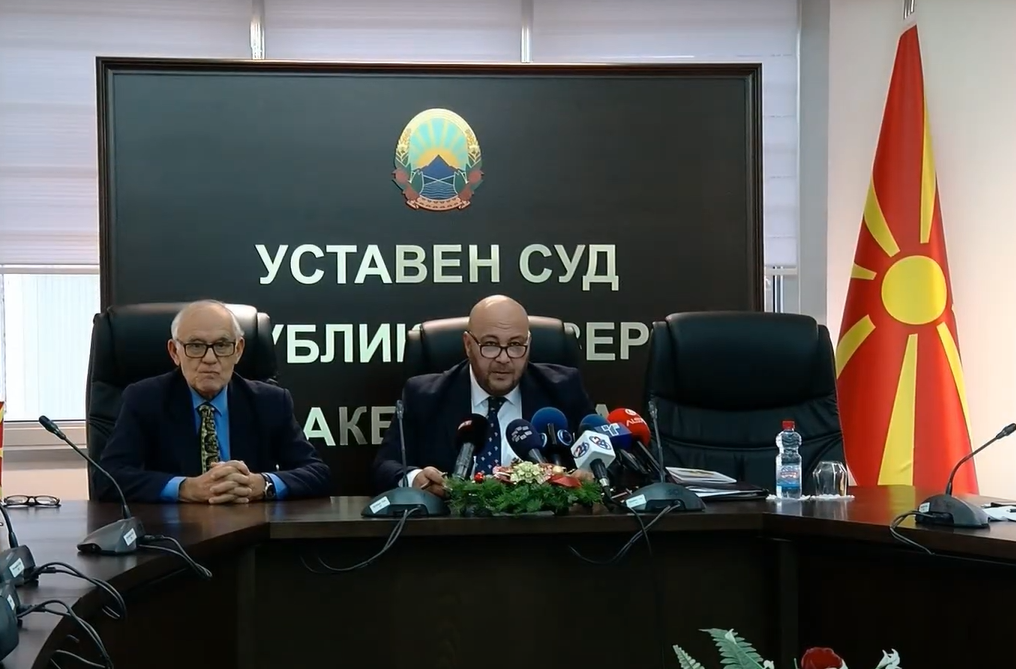
Following the conclusion of the final session of the Constitutional Court in 2025, the President of the Constitutional Court, Dr Darko Kostadinovski, and Judge Prof. Dr Osman Kadriu held a press conference addressing several cases of high public interest.
Key points by President Kostadinovski:
The Constitutional Court today adopted a decision to initiate proceedings for the review of the constitutionality of the amendments to the Law on Judges’ Salaries, with the aim of protecting judicial independence from the executive and legislative branches of power. Judges’ salaries are not a technical matter, but a matter of status which, according to international standards, must not be reduced even in conditions of economic crisis.
This decision does not imply an increase in judges’ salaries; rather, it prevents any further reduction. In other words, this is not about an increase, but about safeguarding constitutionally established authority and the constitutional prerogatives of judicial independence and autonomy.
Generally accepted norms of international law are applied in various forms—whether developed through conventions, opinions and positions of the Council of Europe, the case law of the European Court of Human Rights, or the opinions of the Venice Commission. Once such norms crystallise into standards, the Court is obliged to respect them. In the present case concerning the reduction of judges’ salaries, internationally accepted standards clearly exist. In summary, when applied to the specific case, these standards constitute a guarantee against the reduction of judges’ salaries. More importantly, all of these international standards indicate that judges’ remuneration is not a technical issue, but a status-related matter inextricably linked to their independence and autonomy. Any interference with judges’ salaries, according to international standards, therefore amounts to interference with their independence and autonomy.
Key points by Judge Kadriu:
We adopted the position that the contested provisions are contrary to the Constitution and constitutional principles for the following reasons:
If the principle of separation of powers is violated in a state, that state effectively has no Constitution.
The Law on the Public Prosecutor’s Office contains a provision stipulating that the salaries of public prosecutors may not be reduced; however, it also contains a contradictory provision stating that, by way of exception, salaries may be reduced in cases determined by law. When adopting the law, the legislator relied on these provisions as exceptions, yet failed to specify the cases which would entitle it to reduce the coefficients of public prosecutors and members of the Council of Public Prosecutors. It appears to refer to a financial, economic or other crisis as a possible justification, but it remains unclear how and in what manner the reduction was carried out in the present situation.
Furthermore, when a law freezing the salary base is adopted, such a measure may only last for the duration of the specific crisis for which the law was enacted, which implies a clearly defined and limited period of time.
Due to the contradictory nature of these provisions – on the one hand guaranteeing that salaries may not be reduced, and on the other referring to an undefined exception – such ambiguity and lack of precision led to arbitrary decision-making by the legislator to reduce the salaries of both public prosecutors and members of the Council, without any substantiated justification.
This constitutes a direct interference with the financial independence of the Public Prosecutor’s Office. Such financial dependence consequently affects the functional exercise of the public prosecutor’s role.