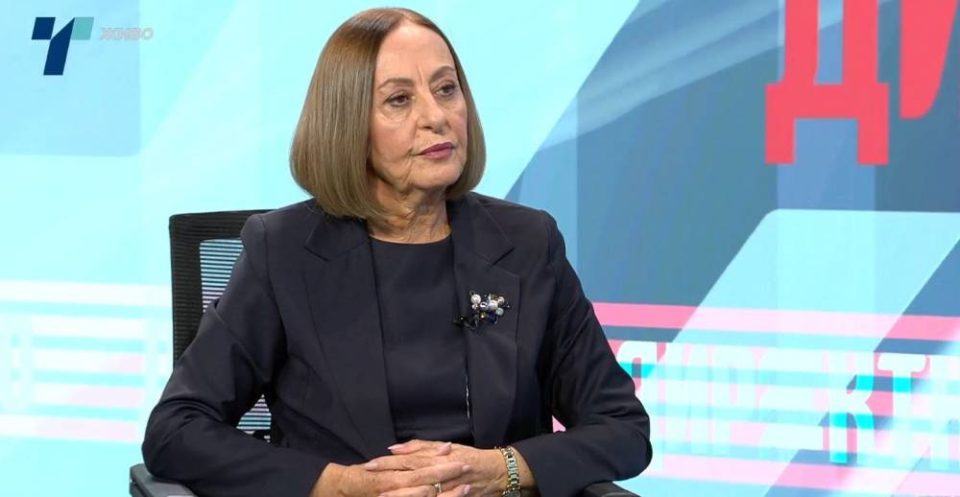
Constitutional Court Judge Dobrila Kacarska, during her appearance on the television programme Direktno on TV Telma on 9 December 2025, responded to questions related to the case concerning the so-called linear increase of pensions and clarified the procedure for the allocation and handling of cases within the Constitutional Court.
“Cases before the Constitutional Court are allocated alphabetically, whereby the Secretary of the Court assigns each case to a judge-rapporteur and to a legal adviser working with that judge. This falls within the competence of the Secretary of the Court. In my case, the matter concerning the linear increase of pensions in the amount of 2,500 denars, applied twice, was assigned to me,” Judge Kacarska explained.
Judge Kacarska stated that inaccurate information had been circulating in the public, particularly claims that she had allegedly signed a final decision or that the Constitutional Court had already decided that pensions would be reduced.
“It is false information that I have signed a final decision, and I categorically deny claims that the Court will decide to reduce pensions. I wish to emphasise that someone has provided the Prime Minister with incorrect information-whether intentionally or unintentionally, I do not know-but he publicly stated that I had signed the final decision and that pensioners would be required to return the 5,000 denars. The Prime Minister is not a lawyer by profession, and it is therefore understandable that he may not be familiar with court procedures. However, the question remains as to who misled the Prime Minister by providing such false information. Whether this came from someone within the Constitutional Court or from an adviser, I cannot say. The Prime Minister himself should question who gave him such inaccurate information that a final decision had been signed. There is no final decision-only a decision to initiate proceedings. Even that decision has not yet become final, as it has not been signed by me. The draft decision is currently pending before the Constitutional Court’s Editorial Committee,” Judge Kacarska stated.
She further explained the difference in the treatment of the initiatives concerning the linear increase of 5,000 denars and those relating to the increase of 2,000 denars, emphasising that the timing was decisive:
“Given that the case report was prepared several months ago and placed on the agenda at the end of October, the proposal contained therein was to initiate proceedings. However, since the law in question was of a temporary nature and was no longer part of the legal order, I proposed at the session that the initiatives concerning that linear increase be dismissed. It is true that some judges proposed initiating proceedings and annulling the law, but I would in no circumstances support such a proposal. Even if I were outvoted, I would not vote in favour of annulling that law. It is of a temporary nature and is no longer part of the legal order,” the Judge stated.
Judge Kacarska also announced that 17 initiatives related to the new linear increase of pensions had been submitted to the Constitutional Court, which led the Court to decide to initiate proceedings ex officio in order to consider those initiatives concurrently.
“Given that 17 new initiatives concerning this new linear increase of two instalments of 1,000 denars have been submitted to the Court, in a case that is currently being processed and is expected to be placed on the agenda within a month or two, my proposal as judge-rapporteur was that we proceed simultaneously with those 17 initiatives. This is something permitted by our Act. I believe the decision was adopted unanimously, or possibly with one dissenting vote. I think seven judges voted in favour of the proposal. These are initiatives already formally submitted to the Court. Under no circumstances, as was stated from the parliamentary rostrum, does this concern any private initiative of my own. Nor is this the first time that the Constitutional Court has proceeded in this manner.”
She once again emphasised that no final decision had been adopted and that the proceedings were ongoing. With regard to the possible outcome of the case, Judge Kacarska explained the implications of a potential repeal of the law:
“If we were to adopt a decision to repeal that law, pensioners would receive a proportional increase in pensions rather than a linear increase of 1,000 denars. This would correspond to the March pension increase. We have expressed doubts that several constitutional provisions have been violated by this law – Article 8, paragraph 1, indents 3 and 6, concerning the rule of law and property; Article 9 on equality; as well as Articles 30, 34, and 52 of the Constitution. Multiple constitutional provisions are at issue, and precisely for that reason we expressed doubts and initiated proceedings,” Judge Dobrila Kacarska stated in the interview for the programme Direktno.