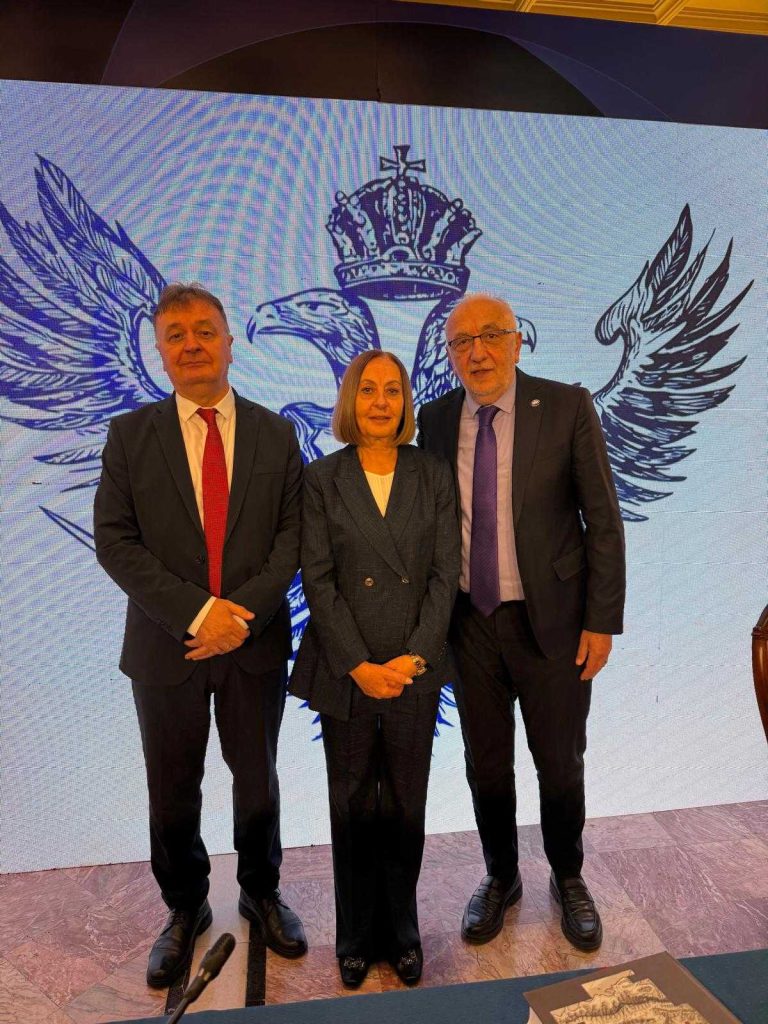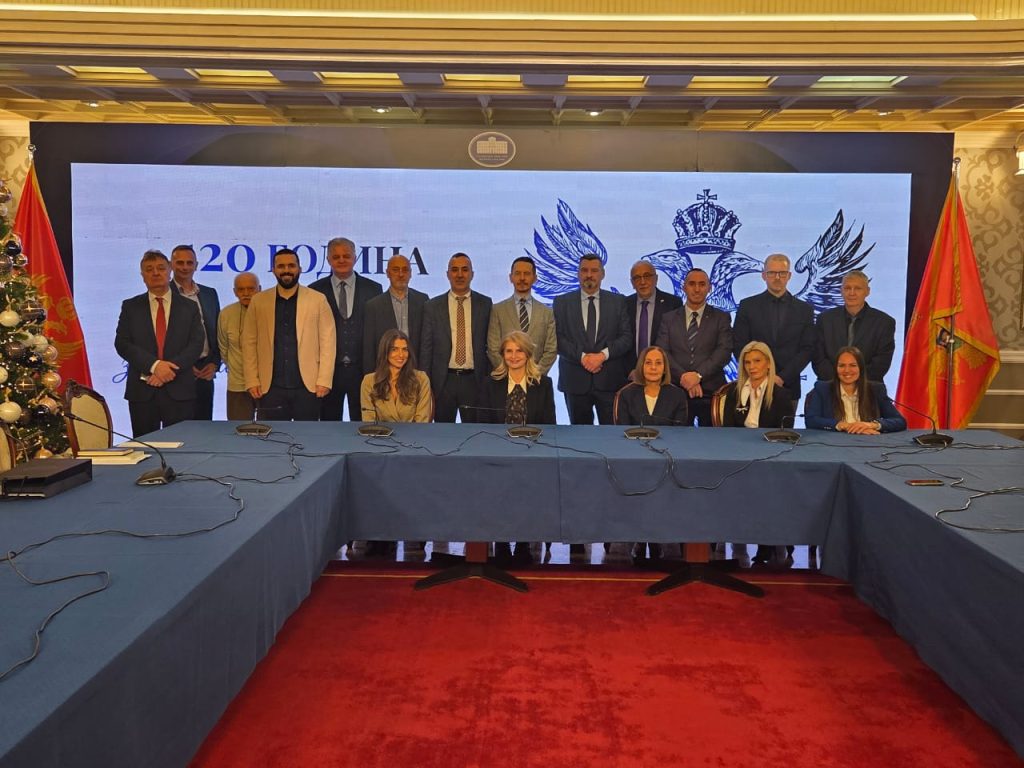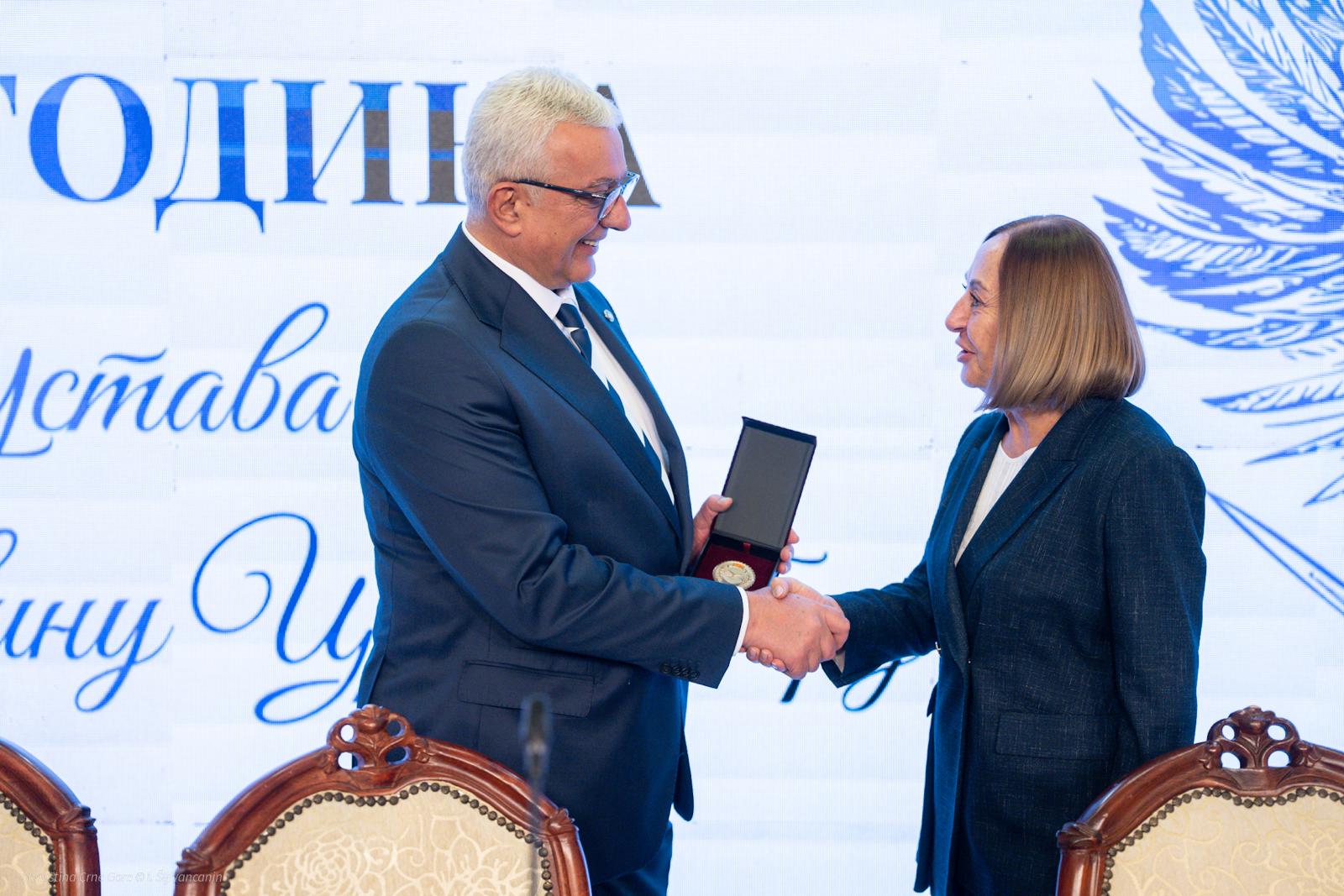
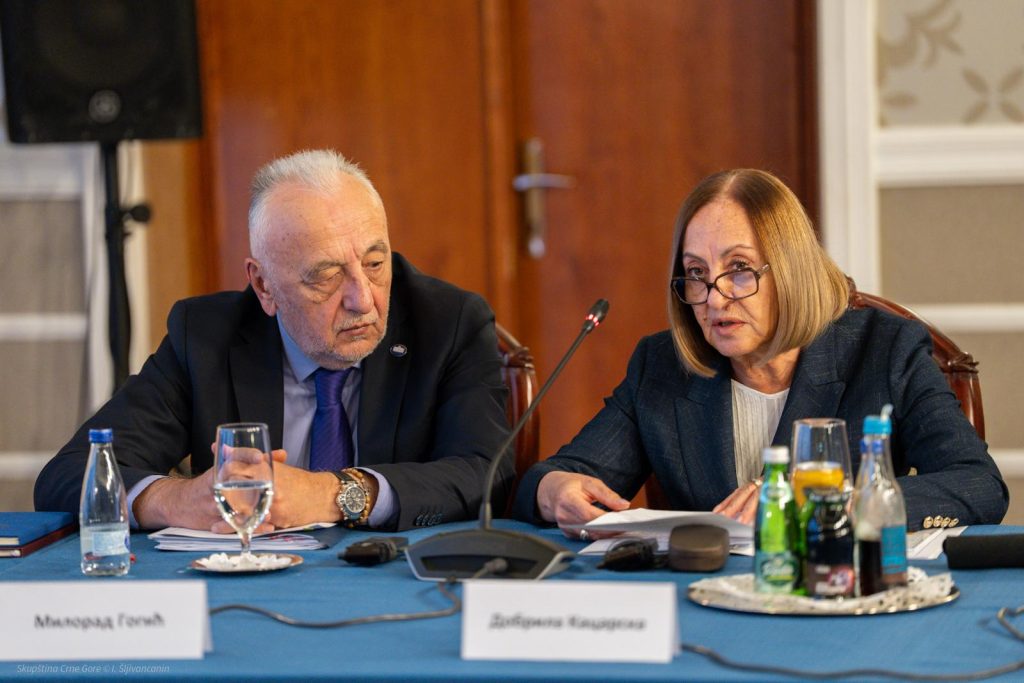
At the personal invitation of the President of the Assembly of Montenegro, Mr Andrija Mandić, Constitutional Court Judge Dobrila Kacarska delivered an address in which she reflected on constitutional tradition and transformation through a comparative overview of the Constitution of the Principality of Montenegro of 1905 and the Constitution of the Republic of North Macedonia of 1991. The Macedonian delegation also included Jasmina Simonovska, Adviser of the Court.
We present the full text of Judge Kacarska’s address:
Honourable President of the Parliament of Montenegro,
Distinguished ladies and gentlemen,
Today, on the occasion of marking 120 years since the adoption of the Constitution of the Principality of Montenegro of 1905, I address you as a representative of the Constitutional Court of the Republic of North Macedonia.
At this event, we are not merely commemorating the anniversary of the adoption of a document, but also the birth and materialisation of a constitutional vision that placed Montenegro among the modern states of Europe, at a time when the constitutional idea had yet to take root in many parts of the continent.
For this reason, Professor Dr Šuković has rightfully described this constitution as “one of the most significant legal monuments in the history of Montenegrin legislation, and in the history of the culture and statehood of Montenegro”.[1]
The Constitution of 1905 is a product of political courage and legal wisdom. Through it, the idea was embodied that state power must be legally constrained and, in order to be legitimate, must serve the people.
With this act, the National Assembly was established – the first Montenegrin parliament, thereby beginning a tradition which this year marks 120 years, a true rarity for our region.
Dear all,
For us, constitutional judges, the one hundred and twentieth anniversary of the adoption of such a document is an opportunity to reflect upon the enduring principles that connect our past and present: the rule of law, the separation of powers, and the protection of human rights, which are the cornerstones of every democratic order.
When the Republic of North Macedonia adopted its Constitution in 1991, it too stood at a similar historic turning point. Both our nations sought to define their sovereignty through a constitution, to limit state power by principles, and to protect the individual from arbitrariness and abuse.
In this sense, the constitutional traditions of Montenegro and the Republic of North Macedonia are separated in time, yet united in spirit. The Constitution of the Principality of Montenegro of 1905 was among the first in South-East Europe to affirm the fundamental rights of citizens, and its values clearly resonate within the Macedonian Constitution of 1991.
Allow me briefly to reflect on this parallel through the prism of rights and freedoms. The Montenegrin Constitution of 1905 guaranteed the inviolability of personal liberty, proclaiming that no one may be deprived of liberty or detained except in cases prescribed by law, and that punishment must likewise be determined by law. In addition, the provisions on the inviolability of the home, freedom of religion, freedom of expression and of the press, and the right to submit petitions concerning the work of state authorities were constitutional norms of exceptional significance for their time.
This Constitution, even 120 years ago, envisaged the protection of private property as the foundation of personal independence, recognising it as a right that may be restricted solely for the public interest and with just compensation – a provision that is practically mirrored in our contemporary Macedonian Constitution.
I must particularly draw attention, given the time distance from the moment of the adoption of this Constitution, to the fact that it also provided for the establishment of local self-government, that is, municipalities in which directly elected representatives decide on matters of local nature.
In our modern constitution, this is a fundamental value of the constitutional order, accompanied by a dedicated section addressing this matter. Its importance is immense for every democratic society, since democracy, among other things, implies that locally elected representatives, and not the central authorities, decide on matters concerning the citizens who reside within the territory of that unit of local self-government.
These principles, together with others not mentioned here, were revolutionary in the Balkans at the beginning of the twentieth century, when a large part of the population were still subjects rather than holders of rights.
Almost a century later, the Constitution of the Republic of North Macedonia affirmed and expanded these freedoms within a democratic context. It guarantees the right to life, personal liberty and security, freedom of belief and conscience, freedom of thought and public expression, freedom of assembly and association. It recognises equality before the law, the prohibition of discrimination, and the right to privacy and dignity – modern articulations of principles that Montenegro had already established in 1905.
In both constitutions, we see the same moral foundation: the state exists to serve the citizen, and not the other way around. The Constitution of Montenegro, protecting rights in the language of its time, and the Constitution of the Republic of North Macedonia, embedding international human rights standards, confirm that freedom and legality are inseparable.
As judges of constitutional courts, we are entrusted with the mission of preserving this legacy, ensuring that these rights remain living guarantees and not distant declarations. Every constitutional decision we adopt continues the dialogue initiated by the Montenegrin Constitution of 1905: a dialogue between power and principle, authority and freedom, the state and the citizen.
The Montenegrin Constitution of 1905 and that of North Macedonia of 1991 both sought to balance continuity and change – to honour tradition while embracing the future. Both were guided by the belief that national identity is best preserved when rooted in justice, equality and respect for human dignity.
The Constitution of 1905 was ahead of its time, both in its vision and in its spirit. It anticipated the European legal order that would emerge decades later – one based on the rule of law and human rights. Therefore, it is no exaggeration to say that Montenegro’s constitutional experience forms part of Europe’s shared constitutional heritage.
Today, as Montenegro marks this anniversary, we in the Republic of North Macedonia join you with admiration and respect, participating in this commemoration as partners on the same constitutional journey, one that leads towards a stronger democracy, a deeper respect for human rights and closer integration into the European family of nations.
May this anniversary remind us that constitutions are not monuments of the past, but living compacts of the present – renewed each day through the work of our courts, institutions and citizens.
On behalf of the Constitutional Court of the Republic of North Macedonia, allow me to extend my warmest congratulations to the people of Montenegro and to this institution – the Parliament of Montenegro, in which their representatives serve.
I sincerely hope and wish that your Constitution of 1905 will continue to inspire future generations, and that the values it proclaimed will remain a lasting bond between our nations.
Congratulations, Montenegro, on 120 years of constitutional vision and courage.
Thank you.
[1] “Ustavno pravo, univerzalna ustavna tematika i ustavno pravo Crne Gore”, prof.d-r Mijat Šuković, CID Podgorica, 2009, page 147.