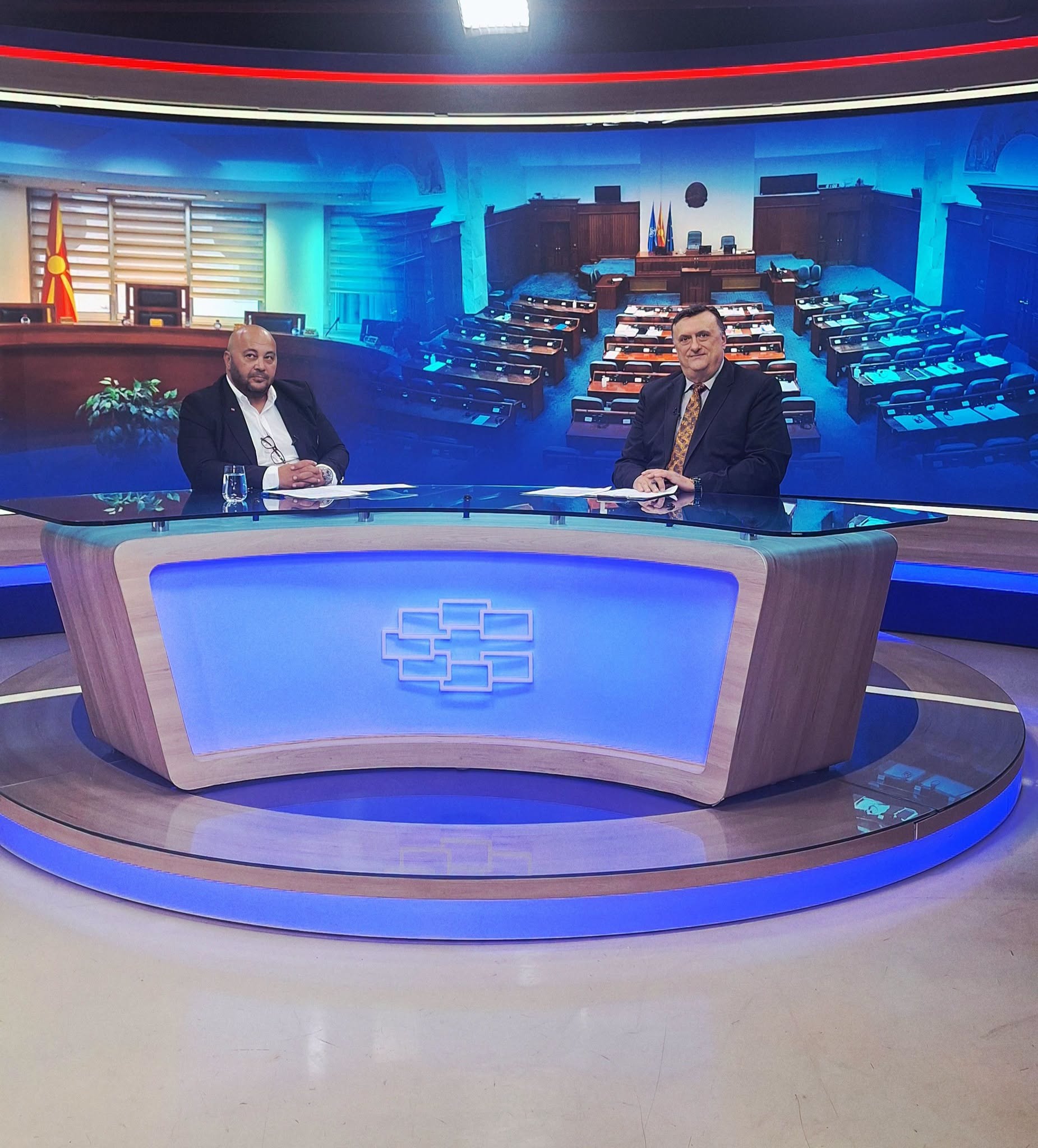
On 24 June 2026, the President of the Constitutional Court, Dr. Darko Kostadinovski, appeared as a guest on the main evening news programme of TV Sitel, in the segment “Topic of the Day.” Kostadinovski addressed current issues and challenges related to the work of the Court, spoke about the initiative to align the salaries of constitutional judges, cases currently before the Court, as well as criticism directed at the institution.
Regarding the repeal of the Law that reduced the coefficients used to calculate the salaries of constitutional judges, as well as the request submitted to Parliament for legislative amendments that would harmonize the coefficients used to calculate constitutional judges’ salaries, Kostadinovski stressed that this was a legally and constitutionally justified decision intended to protect the status of judges, rather than primarily to increase their salaries, as it has been interpreted in the public.
“As constitutional judges, we understand that many of the decisions we make are unpopular decisions, and we are aware of that. This is one such decision. But people who understand the law and who have followed our decisions can see this decision as a natural consequence, as legally logical and constitutionally justified, and I will explain why. At the beginning of the year, the Constitutional Court adopted a decision which, with its effect, increased the salaries of judges in the ordinary judiciary by approximately 10,000 denars—between 10,000 and 12,000 denars, depending on the court. The effect of that decision was not so much to increase judges’ salaries as to prevent the Government and Parliament from being able to reduce the coefficients for the ordinary courts in the future.
When we adopted that decision, the Constitutional Court was also a court by all criteria. It is true that it is a specific sui generis court, a special court, a specific organ of the Republic, but at the end of the day, it is a court. According to the Venice Commission’s opinion, we enjoy the same guarantees of judicial independence as the ordinary judiciary, including financial independence, which is inseparably connected with our status as independent judges.
If that is the case—and it is—then it was natural for us to intervene in the Law, but again, I will emphasize, not directly with regard to the coefficients, but in terms of status, so that we would be separated from holders of public office in the other branches of government. Under the latest legal provisions in the Law on Elected and Appointed Officials, the President of the Constitutional Court and constitutional judges were placed under the same regulatory regime as the Secretary-General of Parliament, the Secretary-General of the Government, and the Ombudsman. There is no such thing anywhere in the world. The legislature cannot, as a matter of law, equate the status of a constitutional judge with that of any of these branches of government.”
Asked whether the Court could act in this manner toward the legislative branch, Kostadinovski replied:
“No, absolutely not. We established the unconstitutionality of the judges’ status because, if you equate a constitutional judge with the Secretary-General of Parliament and the Government and assign them the same salary coefficient, does that not constitute a denial of their constitutional status? Absolutely it does, and any constitutional court in the world would confirm that.
We also adopted a decision at the beginning of the year and gave Parliament a deadline to intervene. Parliament did not intervene. The decision we adopted at the last session is therefore a logical decision.
To prevent an absurd situation… next year, because the salaries of ordinary judges can no longer be reduced and the average salary will continue to rise—you know what the calculation formula is—for one to two years, the salary of a basic-level judge will be higher than that of a constitutional judge. If anyone in this country can find a similar example anywhere in the world, I am prepared to leave the Constitutional Court immediately.”
Regarding the case concerning the renaming of streets and other infrastructure facilities in the Municipality of Tetovo, Kostadinovski said that the initiative was not filed 19 years ago, but last year, and emphasized that the case raises a fundamental question concerning the rule of law.
“What I want citizens to know is that politicians very often manipulate and lie about many of our decisions. And they lie to citizens without any restraint. This decision, like many other decisions of the Constitutional Court that have greater social significance—the so-called ‘Balancer,’ the Solidarity Tax Law, the Criminal Code, the Electoral Code—raises one crucial question: What kind of state do we want to build?
Do we want to build a modern, European, functional state governed by the rule of law, or do we want to remain what we have had for decades—a ‘quasi’ rule-of-law state?
What is a ‘quasi’ rule-of-law state? It is a state where politics is above everything, politics is above the Constitution, politicians are above institutions, politicians decide on citizens’ rights, and power lies with politicians.
We want to live in—or, as President of the Constitutional Court, I stand for resistance against—those tendencies.
‘A black day for Albanians,’ ‘they are destroying the foundations of the Framework Agreement’… If the Constitutional Court had allowed such a decision to be made through an ethnic lens, when the decision is purely legal and cannot be anything else… Do you have the Government’s consent? — You don’t. Period!
Imagine if we had looked the other way. Then we would have 80 states within this state, 80 municipalities saying, ‘Wait, you established constitutional-court practice then, so we can do this too; we don’t need consent for a detailed urban plan, we don’t need consent for renaming…’ That is legal anarchy.”
Regarding accusations that he is anti-Albanian, Kostadinovski said:
“I am already immune to these criticisms… I can be anything except ‘anti-Albanian.’ What bothers some politicians is the rule of law, even though their mouths are full of talk about the rule of law, European values and European standards—and that is what they say until noon, while in the afternoon they behave in a ‘Balkan’ manner. That is their problem.
For 35 years we have been going around in circles within this ‘quasi’ rule-of-law state… The Constitution, the law and the institutions will be above everyone.”
Regarding the case connected with the “Safe City” project, the President of the Court said:
“The report for that case has still not been submitted to me. The moment it is submitted, it will immediately be placed on the agenda of a session.”
Regarding the initiative submitted by former MP Ljiljana Popovska concerning the Second Protocol to the negotiating framework with Bulgaria, Kostadinovski emphasized that the Court does not calculate or make political calculations.
“Neither do we calculate, nor will we calculate. The public knows that I do not compromise with anyone on any case, including this one. What is essential is that the allegations in this initiative are extremely serious, and the implications of resolving this case, regardless of how it is resolved, are very serious.
In order for us to establish the factual situation and determine what is actually happening, because there are allegations of violations of substantive constitutional provisions as well as formal violations—that the procedure was not followed and that there was no platform adopted by the Government—we are still waiting for the Government’s response. Since the Government is a party to these proceedings, we must obtain information from the Government.”
Regarding the Law on the Use of Languages, Kostadinovski reiterated that the case would be resolved once the Court is fully constituted.
“I have said that there will be no compromises with anyone regarding its resolution. That case will be resolved, whether someone likes it or not, because it will be resolved, and no one should be afraid of the outcome.
We very often hear criticism of the Constitutional Court about ethnic outvoting and majorization. There are advocates of applying the Badinter principle in the Constitutional Court, and I have a position on this, which I have already stated.
Regardless of ethnicity, neither the Albanian judges nor the Macedonian judges are there to protect ethnic affiliations. We have one simple task…
Unfortunately, despite all the accusations, it is most often the Albanian political factor that accuses the majority of Macedonian judges of carrying out majorization. I often ask: Let us see, let us sit down and examine what makes our colleagues’ arguments legal and constitutional-legal, and what makes ours ethnic. It is not true. It is the opposite.”
Finally, commenting on claims concerning his future professional plans after the end of his term, Kostadinovski said:
“I will not comment on the primitive political narrative. It does not deserve my comment, and I consider this a matter of self-respect.
But I will say that over the past 30 years I have accumulated a great deal of knowledge, experience and professionalism, while my academic contribution is also quite significant.
If we were a normal country, the question of my personal career after the end of my term would not be politicized or subjected to political qualifications. But unfortunately, we are not.
I must say that I am somewhat surprised and disappointed. I see similar tendencies even within parts of higher education as in politics—closed-mindedness, fear of competition, fear of an impressive CV, and a certain level of comfort,”
Kostadinovski said in his interview for TV Sitel.